Apple Maggot
Apple maggot flies begins to emerge in Wisconsin in early July, and will soon begin laying eggs inside our apples, causing the characteristic “worm in the apple” damage if left untreated. We recommend you monitor for apple maggot beginning in late June, using extra diligence in orchards which are surrounded by untreated apple, hawthorn, dogwood, or crabapple trees.
| Common Name | Apple maggot |
| Order | Diptera |
| Family | Tephritidae |
| Scientific Name | Rhagoletis pomonella (Walsh) |
Identification and Life Cycle
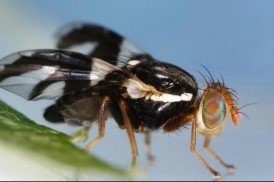
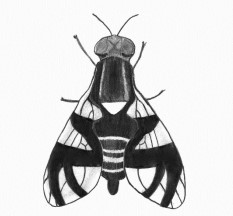
The adult apple maggot fly is approximately the size of a house fly, with an “F”-shaped pattern on the wings. Apple maggots overwinter in Wisconsin as pupae, and adults emerge beginning in late June or early July. These adults begin by feeding for 7-10 days (on honeydew or another sweet substance), sometime in the orchard but often in nearby landscapes. By mid-July the first adults will most likely begin laying eggs under the skin of apple trees. Each female will lay around 300 eggs over the course of her lifespan. Because not all adults emerge immediately in July, some apple maggot adults will continue to lay eggs in apple fruit through August or even September.
The eggs hatch into to larval stage, known as maggots or “worms,” inside the fruit. This is the life stage that does the damage, as each larva will feed within the fruit throughout its lifespan. Unlike caterpillar pests, such as codling moth (which feed mainly on the seeds and within the apple core), apple maggot larvae feed throughout the apple flesh by breaking open the cells then absorbing up the sugary juice. Each larva will feed for two to six weeks, and often this damage causes the fruit to fall prematurely from the tree. After growth is complete, the larva will crawl out of the fruit and pupate in the soil. There is only one generation in Wisconsin, and in fact some larvae may take over a year to develop, not emerging as adults until after spending two winters in the soil.
Damage Symptoms
Apple maggot is most predominantly a pest of apple, but has been known to also feed on crab apple, cherry, plum and peach. A similar looking pest, the blueberry maggot, feeds on blueberries and other related berries.
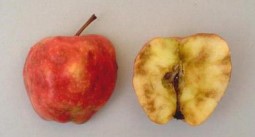
Damage to apple fruit occurs from the maggots’ feeding within the fruit, causing browning and rotting tunnels in the flesh of the apple. After cutting the apple open, damage symptoms of apple maggot can be distinguished from other apple pests in that the brown tunnels are found throughout the flesh of the fruit, instead of being mainly in the central core of the apple. On the outside of the fruit, the egg-laying holes appear as minute dimples. Infested fruit may fall off the tree and fail to develop fully.
Monitoring and Control
Monitoring for apple maggot should begin in late June, to be sure to catch the first adults moving into our orchards. The most up-to-date recommendations are to use red sticky ball traps baited with an apple fruit volatile at a rate of three traps per 15-acre orchard. The traps will work best if they are placed near the edge of the orchard, either nearest to woodland or an abandoned orchard, or on the south side of the orchard. An insecticide application is recommended once a total of five flies per trap have been caught in volatile-baited traps, or after a single fly has been caught in a non-baited red sticky ball trap. It is important to examine the wings of trapped flies carefully, as other species are similar in size and color.
Cultural control: Abandoned orchards or alternate hosts (such as crabapple and hawthorn) often serve as a reservoir to build up apple maggot populations. It is best to remove those alternate hosts from the landscape surrounding an orchard.
Biological control: Native egg and larval parasitoids of apple maggot are present in North America. However, because the egg and larval stages of this pest are both protected in the apple, biological control has not been shown to be an economically important pest control method.
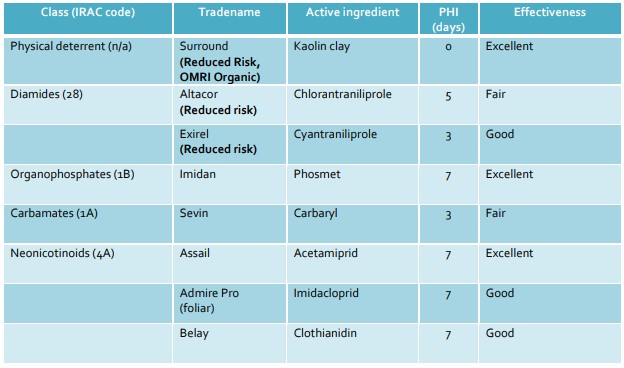
Chemical control: It is recommended to monitor for apple maggot (see above), and to spray within a few days of reaching the economic threshold (one fly in a trap when using non-baited traps or five total flies per trap when using volatile-baited traps). Following the first application, it is recommended to spray every two- to three-weeks until mid-August if using conventional insecticides, or to maintain continual thorough coverage with Kaolin clay.
A list of available insecticides to control apple maggot in apple is provided in the following table. For other affected fruit crops, be sure to read the label to make sure they are registered for that specific crop in Wisconsin. There are many other tradenames available, and we do not recommend these that are listed above other options. All product recommendations can be found in the Midwest Fruit Pest Management Guide. Additionally, you should always fully read and follow the label before spraying any pesticide.