

Early Season Disease Management in Wisconsin Vineyards
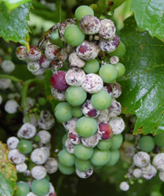
Early-season disease management is one of the most important components of a successful fungicide program in vineyards. From bud break through early fruit development, grape tissues are highly susceptible to infection by several fungal pathogens. Diseases that establish early in the season can be very difficult to manage later, making early-season protection critical for maintaining vine health and protecting fruit quality.
In general, the “early season” in vineyards refers to the period from dormant vines through approximately pea-sized berries. During this window, young shoots, leaves, and developing fruit are particularly vulnerable to infection. Many pathogens take advantage of these tender tissues, and infections that occur early can lead to disease outbreaks later in the season if not properly controlled.
Critical Spray Timing
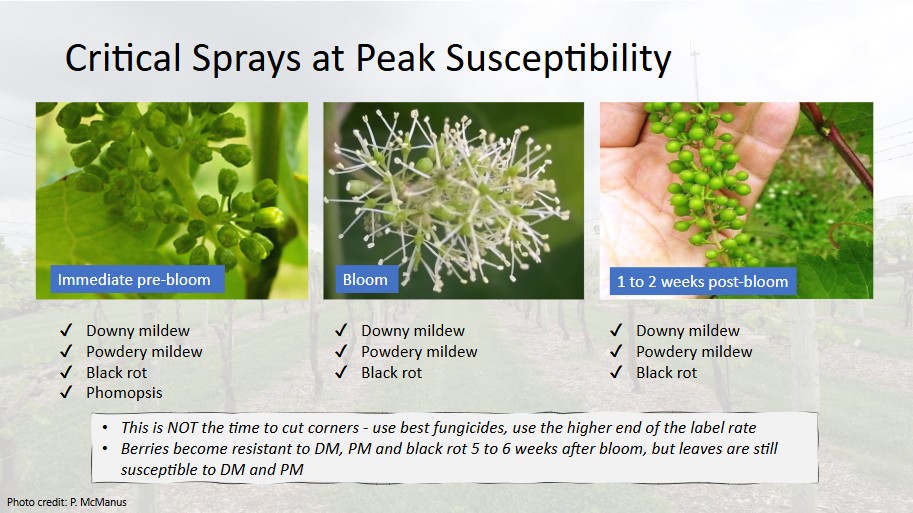
Several important grape diseases are most effectively controlled through fungicide applications made during the pre-bloom to post-bloom period. In most vineyards, three spray timings are particularly important:
- Immediate pre-bloom
- Bloom
- 1–2 weeks after bloom
This window represents the peak susceptibility period to the pathogens associated with black rot, powdery mildew, and downy mildew. Because of this, growers should avoid cutting corners during this time and instead use the most effective fungicides at appropriate label rates.
Most grape berries develop ontogenic (age-related) resistance to several key diseases approximately 5–6 weeks after bloom, although leaves and rachises can remain susceptible later in the season.
Black Rot
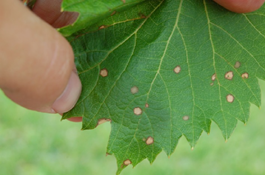
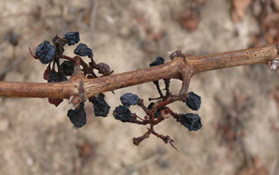
Black rot leaf lesions (left); black rot fruit symptoms (right).
Black rot is one of the most common and damaging diseases of grapes in Wisconsin. The pathogen overwinters in infected berries (mummies) that remain in the vineyard from the previous season. In the spring, these mummies produce spores that infect new shoots and fruit.
Warm temperatures and humid conditions favor infection, making early-season weather an important driver of disease risk. Several cold-climate grape varieties commonly grown in the Midwest, including Marquette, Frontenac, and Valiant, are susceptible to black rot.
Sanitation plays a critical role in managing this disease. Removing mummified fruit from trellises before bud break can significantly reduce the amount of inoculum present in the vineyard.
The most important fungicide window for black rot management occurs from immediate pre-bloom through approximately 2–4 weeks after bloom. Products containing mancozeb or ziram generally provide excellent control during this period, while copper products may offer moderate protection when applied at shorter intervals under high disease pressure.
Downy Mildew
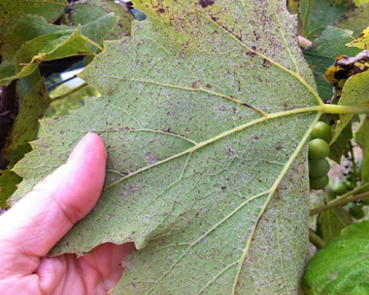
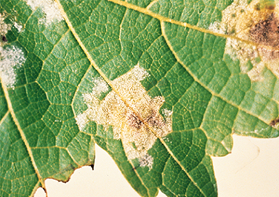
Downy mildew on leaf underside (left); downy mildew leaf close-up (center); downy mildew fruit symptoms (right).
Downy mildew is favored by rainfall and high humidity and often develops rapidly during mild, wet periods. The pathogen overwinters in leaves or soil on the vineyard floor. In the spring, spores are produced during rainy weather and splashed onto young, susceptible tissues.
Initial symptoms are often first observed on suckers or lower canopy leaves which are close to the vineyard floor where downy mildew overwinters in leaves. Fruit typically becomes resistant to downy mildew approximately 3–4 weeks after bloom.
Because downy mildew is strongly influenced by canopy humidity and leaf wetness, cultural practices that promote rapid drying of leaves can help reduce disease pressure. These include maintaining good airflow through canopy management practices.
For chemical control, mancozeb and captan are commonly used protectants. Organic growers often rely on copper products, which can be very effective but should be used carefully on sensitive varieties such as Brianna to avoid potential phytotoxicity.
Powdery Mildew
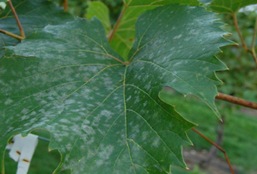
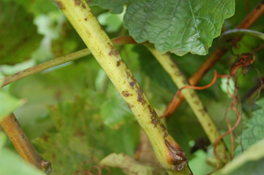
Powdery mildew leaf symptoms (left); powdery mildew cane lesions (right).
Unlike many other grape pathogens, powdery mildew does not require free water to infect plants. Instead, infections are favored by high humidity (greater than 80%) and moderate temperatures between 68 and 80°F.
The fungus overwinters on vine bark and produces spores early in the season. Controlling these early infections is critical because they serve as the source for disease spread later in the season.
Berries typically develop resistance to powdery mildew approximately 3–4 weeks after bloom but leaves and rachises can remain susceptible throughout the growing season.
Effective fungicide options include FRAC Group 3 fungicides such as Rally, Cevya, and Mettle. For organic growers, sulfur remains one of the most effective products, while potassium bicarbonate and horticultural oils can also provide suppression.
Phomopsis Cane and Leaf Spot
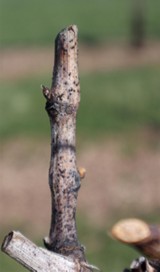
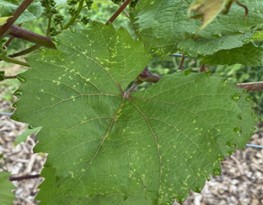
Phomopsis cane spot (left); phomopsis leaf spot (right).
Phomopsis infections are favored by cool, wet conditions early in the growing season. The pathogen survives in infected wood and produces spores that are dispersed during rain events between bud break and bloom.
Early infections on shoots and leaves are particularly important because they contribute to inoculum that can infect fruit later in the season.
Sanitation is the first line of defense against Phomopsis. Removing infected wood during dormant pruning helps reduce inoculum levels. Fungicide applications made during the pre-bloom period are especially important because spore production typically peaks before bloom.
Products containing mancozeb, captan, or ziram are commonly used. In vineyards with a history of severe disease, liquid lime sulfur applied during the dormant season can help reduce overwintering inoculum.
Anthracnose
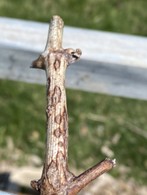
Anthracnose cane symptoms.
Anthracnose is another disease that can cause problems during wet seasons, particularly on susceptible varieties such as Marquette. The pathogen overwinters on infected canes and spreads through splashing rain in the spring.
Infections are favored when wet conditions persist for extended periods; often 24 hours or more of leaf wetness at temperatures above 35°F.
Management focuses on removing infected canes during dormant pruning and applying delayed dormant sprays of liquid lime sulfur, which can help reduce spore production before the growing season begins. Many fungicides used for other early-season diseases also provide control of anthracnose.
Recognizing Non-Disease Issues
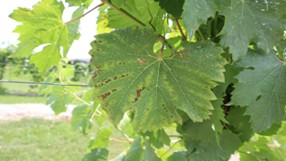
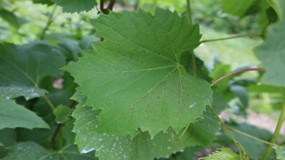
Magnesium deficiency (left); Rupestris Speckle (right).
Not all leaf symptoms are caused by pathogens. Growers may occasionally observe physiological disorders or nutrient deficiencies that resemble disease symptoms.
Examples include Rupestris speckle and magnesium deficiency, which can cause leaf spotting or discoloration but are not caused by pathogens. Correct diagnosis is important before implementing disease management strategies.
Take Home Message
Early-season disease management is essential for protecting grape production in Wisconsin vineyards. Because many pathogens infect vines during the period between pre-bloom and several weeks after bloom, this window represents the most critical time for fungicide protection.
By combining sanitation practices, careful monitoring, and well-timed fungicide applications, growers can significantly reduce disease pressure and prevent outbreaks later in the season.
As always, growers should consult current spray guides and follow pesticide labels carefully—remember that the label is the law.
*Mention of a product is not an endorsement.
Additional resources:
- Midwest Fruit Pest Management Guide: https://ag.purdue.edu/department/hla/extension/_docs/id-465.pdf
- Organic Production and IPM Guide for Grapes (2022): https://ecommons.cornell.edu/server/api/core/bitstreams/e1105b47-df41-49cb-a626-784cf990e7ec/content