

What’s happening with grape cold hardiness this spring?
This time of year often brings large temperature swings, and 2026 is proving no exception. Over the past two weeks, we’ve experienced temperatures as high as 60°F, followed by a sharp drop, with minimum temperatures reaching around 5°F last Tuesday in southern Wisconsin.
With these rapid fluctuations, many growers are understandably wondering how their vines are responding and whether cold hardiness has been compromised.
We do have the grape cold hardiness model available through NEWA, which provides useful predictions based on weather data. In addition, to ground-truth these predictions, we collected bud samples on March 12 from our research vineyards in Verona, WI to directly assess cold hardiness.
Below is a summary of the median bud cold hardiness values for several cultivars. We evaluated cold-climate wine grapes including Petite Pearl, Frontenac, La Crescent, Brianna, and Marquette, as well as seedless table grapes such as Reliance, Mars, Somerset, and the newer University of Minnesota cultivars LumiGlow and LumiShadow.
Based on these data, all cultivars we evaluated appear to have maintained sufficient cold hardiness to avoid damage from the recent cold event at our southern Wisconsin site.
That said, conditions can vary significantly across locations. We strongly encourage growers to collect their own bud samples and perform bud dissections to assess damage in their vineyards. This information can be very valuable for making informed pruning decisions and adjusting management practices as needed this spring.
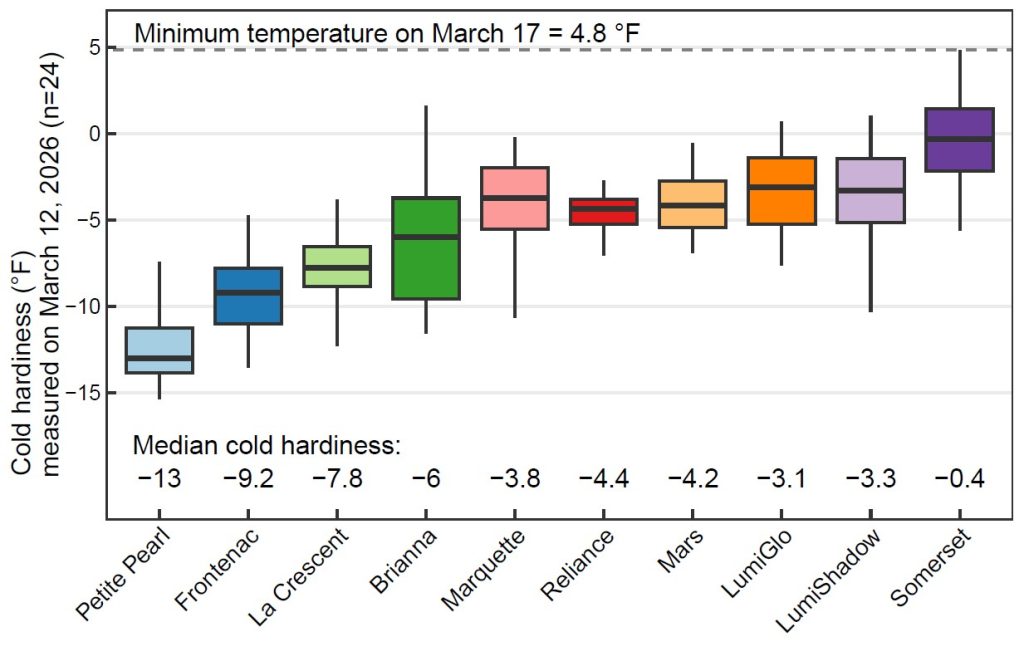
Figure 1. Median bud cold hardiness (LT₅₀; temperature at which 50% of buds exhibit cold injury) for wine and seedless table grape cultivars at the West Madison Agricultural Research Station in Verona, WI. Bud samples were collected on March 12, 2026.
This article was posted in Grapes and tagged Amaya Atucha, Grapes.