

Weather station maintenance reminder
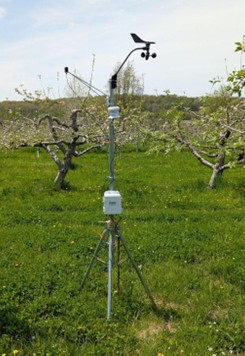
It is that time of year again to test out the function and overall status of your on-site weather station to ensure accurate readings during the growing season. Accurate weather data collection is essential for reliable model predictions. The models we use in NEWA are only as good as the data collected from your weather station, so ensuring that sensors and equipment are functioning properly is critical for obtaining an accurate forecast and making the best possible management decisions. Below is a checklist to work through prior to green tip:
General Maintenance
- Check sensors to make sure they are clean and free of debris and in good condition.
- Clean solar panels that power the battery with an alcohol wipe or clean, damp cloth
- Inspect cables, mounting brackets, poles and posts to ensure they are stable and securely fastened.
- Check the support pole and radiation shield for any insect or critter nests. Consider covering holes with duct tape.
Note: Do not seal the Temperature or Relative Humidity shield. - If a part or sensor needs replacing, get the serial number prior to contacting the vendor to ensure you receive the correct version.
Calibration
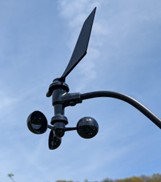
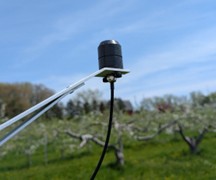
Wind speed and direction sensor (left), leaf wetness sensor (right).
- Best practice is to send your weather station in to the vendor for calibration every 2 years, in the late fall or winter.
- Relative humidity and temperature sensors: Compare readings of sensors with a calibrated thermometer or nearby weather station. Keep an eye on relative humidity sensors. During dewy mornings, low RH readings may indicate a malfunction.
- Precipitation gauges: Turn off the weather station and remove the bucket at the base of the rain gauge. Clear out the drain hole and clean the collector and bucket with warm soapy water. Rinse well. Turn back on after cleaning.
- Leaf wetness sensors: Ideal placement is facing north at a 45 degree angle from horizontal. Check the plastic grid for cracks.
- Wind speed: Ensure the anemometer spins freely. Compare to handheld wind gauge to assess accuracy.
- Wind direction: Wind vane should be set to zero on due North for accurate readings and ensure it moves freely.
- Solar radiation: Clean glass diffuser with a damp cloth and replace if there is yellowing. This sensor is used for the apple carbohydrate thinning model.
Resources:
Placement – Guidance on weather station placement (NEWA)
Maintenance – Guidance on weather station maintenance (NEWA)
Onset Data Loggers
Matt Sharp, Strategic Sales Representative
Environmental & Agricultural Monitoring
508.473.3126
matt_sharp@onsetcomp.com
KestrelMet
Brad Luscombe, Manager
Support, Sales, and Service
207.801.4043
bluscombe@rainwise.com