

IPM Mating Disruption
The goal of any integrated pest management program is to use a variety of techniques to control a targeted pest. This helps limit problems with developing pesticide resistance and often is more effective. One specific, non-insecticidal technique that can be used for insect control is mating disruption.
Many insects communicate with each other using pheromones: scents released by one insect to communicate with another insect of the same species. With moths in particular, female moths release a pheromone plume that male moths of the same species follow until they locate the female. Scientists have been able to identify the exact scent (pheromone) composition and have copied it to make a synthetic version that can be mass-produced. Large amounts of insect pheromone are then applied to a field through a dispenser like rubber tubing, plastic wafers, hollow fibers, puffers, wax matrices or sprays. This is essentially like saturating the field with the scent of a female moth, thereby preventing the male moth from determining the location of the female, which disrupts mating. This is also beneficial because any insect or other organism in the field is not affected by this species-specific pheromone; only the targeted species.
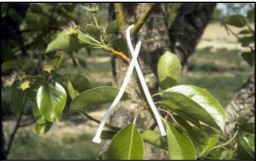
The goal of mating disruption is to decrease the probability of successful mate finding, thus reducing the number of offspring in the subsequent generation. Mating disruption is most efficient in areas of relatively low pest density, since in high pest density areas there is a greater probability that males and females will find each other by chance or by using visual cues. Often this limitation is addressed by using a preliminary insecticide spray to reduce the pest population before mating disruption is employed. Mating disruption is also most effective when applied over very large areas or isolated populations since that limits the number of the pest that can enter the area from off-site. Therefore, mating disruption is usually not practical for small-scale agriculture (less than ten acres) or for a backyard gardener.
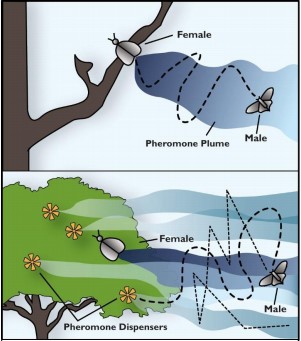
A key consideration for successful mating disruption is the proper means of dispensing the pheromone. Different pheromone dispensers have been developed for different species so that they release the appropriate amount of pheromone for a certain length of time (i.e., the pheromone must be present for the full duration of time when the adult insects may be mating). Also, since pheromones are airborne signals, the dispenser must be placed in an area of the field where the pheromone will not rapidly blow off the field. Lures are commonly placed inside tree canopies where the insects mate or above crops where the insects fly when searching for a mate.
There have been many success stories using mating disruption, and it is a staple in many pest management programs in conventional as well as organic production systems. In Wisconsin, currently, the only product commercially available for mating disruption in fruit crops is for the codling moth, however there are many other products commercialized in other states or in development for other species.
This article was posted in Insects.